We hold these truths
페이지 정보
작성자 IdealAdventure (72.♡.206.180) 작성일 26-06-18 14:07 조회 1,036 댓글 0본문
We hold these truths
What students learn about America’s past shapes their perception of its future
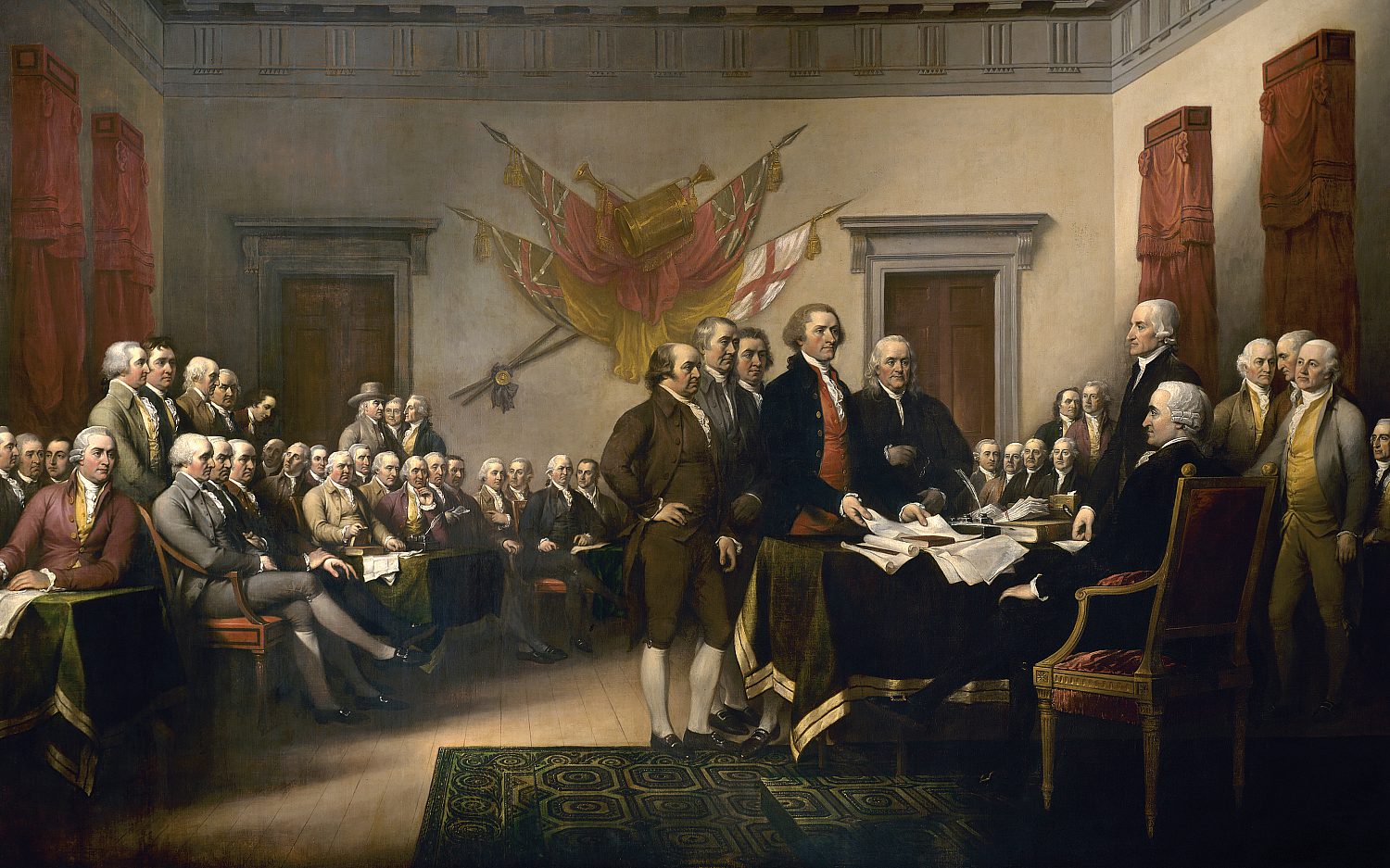
Declaration of Independence, by John Trumbull
On a drizzly Friday morning in March, gray sheets of cloud set off an oversized artistic rendering of Gen. George Washington’s fleet crossing the icy Delaware River. The mural was plastered on the side of a massive 18-wheel semitruck parked outside a historic inn and tavern in Middletown, Va. Dozens of people shuffled through the trailer, which had been turned into a compact two-room museum.
The semi is one of a fleet of six Freedom Trucks crisscrossing the country to mark the 250th anniversary of the Declaration of Independence. Before making its way to Middletown, the truck spent a few weeks in Florida, visiting schools and the state fair. It headed to Birmingham, Ala., next, as part of a nationwide campaign called Freedom 250. A network of conservative groups including Hillsdale College, Turning Point USA, and PragerU partnered with the White House to facilitate the displays and other events commemorating the semiquincentennial. The campaign received a $14 million federal grant from the Institute of Museum and Library Services to help bring the mobile museums to life.
The goal of the Freedom Trucks is to spark patriotism in younger generations and teach them about America’s founding. “We’re really trying to bring students in,” said Jaclyn Gest, one of the truck’s tour managers. “It’s a different way for them to engage with that history.” About 700 students from the local middle school as well as private schools and charter schools in the area around Middletown had already toured the truck, Gest said.
That day, three young girls inside the truck took turns crouching to sign their names at the bottom of a floor-to-ceiling electronic representation of the Declaration of Independence, one of several interactive digital displays. One left a heart next to her digital signature.
But not everyone loves the mobile museum’s overtly patriotic vision—or the White House’s collaboration with conservative groups to commemorate the nation’s 250th.
One critic, Jemar Tisby, a historian and author who professes Christianity and writes about religion and race, blasted PragerU’s involvement, calling the group “an engine of right-wing historical revisionism, built to indoctrinate rather than inform.” Tisby is among detractors who accuse the Trump administration of a form of historical revisionism that overcorrects and whitewashes injustices from America’s past in the name of reviving patriotic education.
“A White House that rewrites the nation’s origins cannot be trusted with its future,” Tisby wrote. Since the start of Trump’s second term, clashes over how America’s history is portrayed have been on full display, from national landmarks to classrooms and statehouses, leaving teachers and parents to wade through conflicting ideas and shifting standards. Political and ideological divides shape how many students learn about America’s past and perceive their role in its future.
Now, as the nation turns 250, a milestone that should invoke patriotism and national pride, younger generations are caught between competing visions of America.
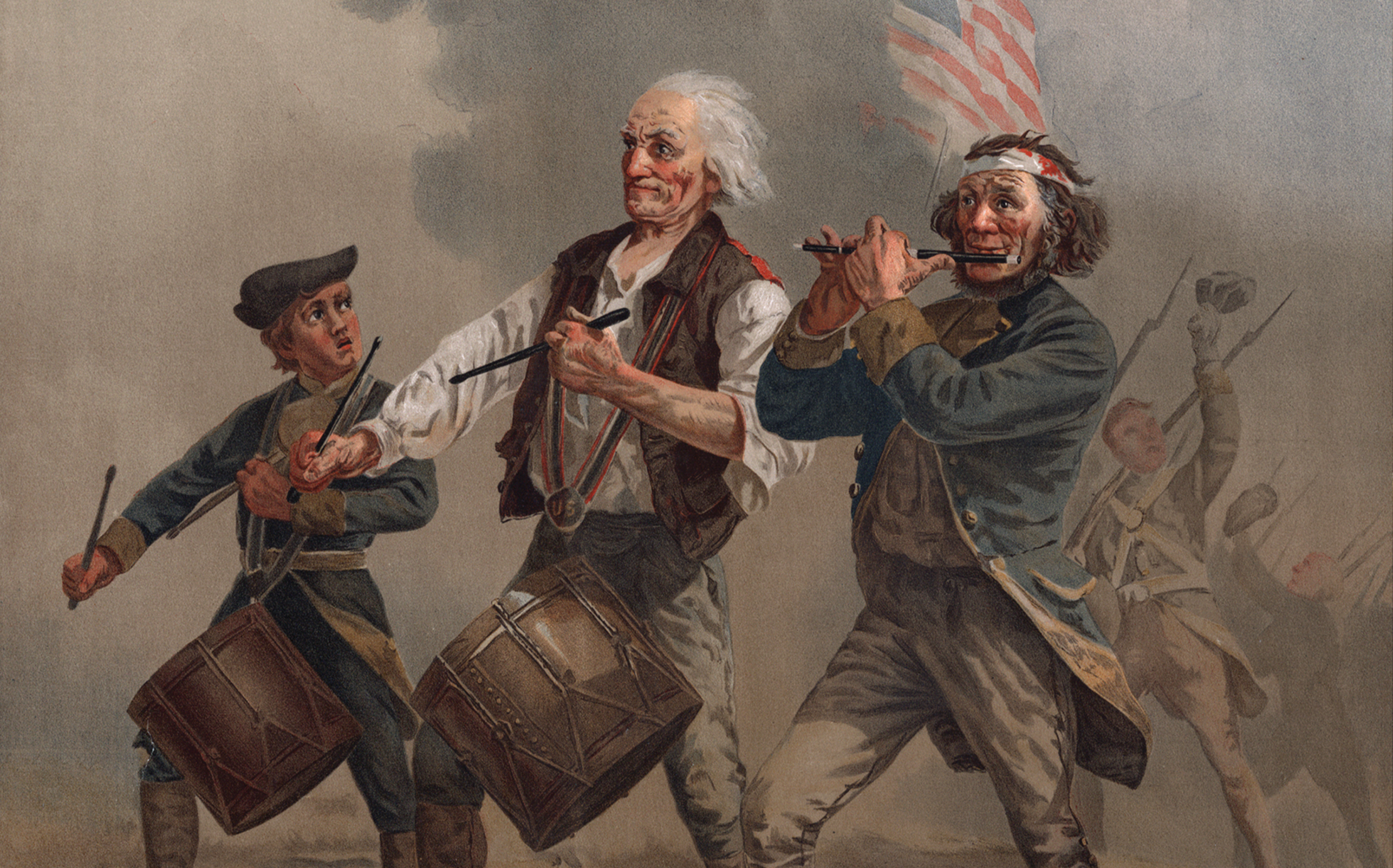
Spirit of ’76, by Archibald Willard
JONATHAN DEN HARTOG IS AN AUTHOR and chair of Samford University’s department of history. He says history itself is being contested. “So that makes it hard to communicate a clear, resoundingly patriotic story that would help renew us. Some progressives will say we shouldn’t even celebrate American independence, that we should mark it, but not celebrate it.”
Earlier this year, the tension was evident at Independence National Historical Park in Philadelphia, where Washington once lived and the Declaration of Independence was adopted. In January, park staff removed an outdoor exhibit at the President’s House Site about nine people enslaved by Washington. They soon reinstated it in what turned into a standoff between President Donald Trump and the city of Philadelphia. In March 2025, the president issued an executive order directing the Park Service, a part of the Interior Department, to review materials at national sites to ensure they “focus on the greatness of the achievements and progress of the American people” and do not “inappropriately disparage Americans.”
The city of Philadelphia sued the Trump administration, contending slavery is central to the National Park’s story. Siding with Philadelphia, U.S. District Judge Cynthia Rufe, an appointee of Republican President George W. Bush, sharply rebuked the Trump administration for what she deemed “dangerous” overreach. The Trump administration appealed the ruling and condemned the city’s lawsuit as aimed at “demeaning our brave Founding Fathers, who set the brilliant road map for the greatest country in the world.”
In April, the appeals court ordered Trump to “preserve the status quo” and leave the slavery exhibits intact as the case moves forward.
Trump’s executive order, “Restoring Truth and Sanity in American History,” puts the conflict at Independence Park in a broader context of what the administration called a historical “revisionist movement.” It’s one Trump has been warning about since 2020. The order claimed America’s past and achievements are being undermined and cast in a negative light, one that’s “replacing objective facts with a distorted narrative driven by ideology rather than truth.”
In the past year, the Trump administration has taken other steps, including bringing back statues of historical figures such as Christopher Columbus, various Confederate generals, and early American leaders. Dozens of historical statues were toppled, vandalized, or officially taken down amid the 2020 protests that followed George Floyd’s death.
The turmoil has spilled over into classrooms. More than half of U.S. teachers polled by EdChoice and Morning Consult in September 2025 said they had modified their curricula or classroom discussions due to political pressure, a 13% jump from March 2025. More teachers are moving away from traditional textbooks and leaning on their own curated materials, according to a 2024 survey of middle and high school history educators conducted by the American Historical Association (AHA).
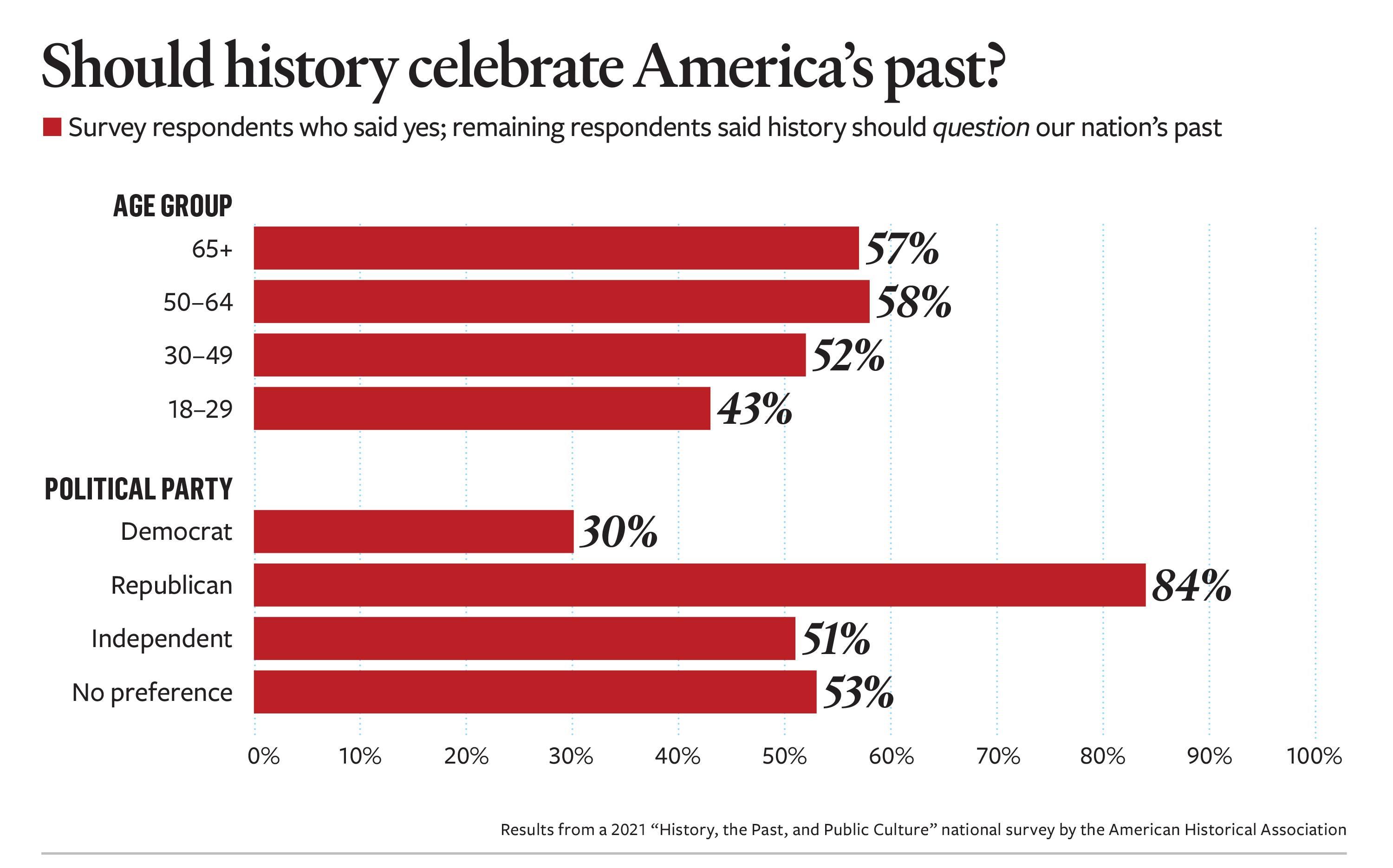
But political affiliations shape how educators teach about America’s past. Another AHA survey from 2021 found that 70% of Democrats said the study of history should question the past, while 84% of Republican respondents said the goal was to celebrate it.
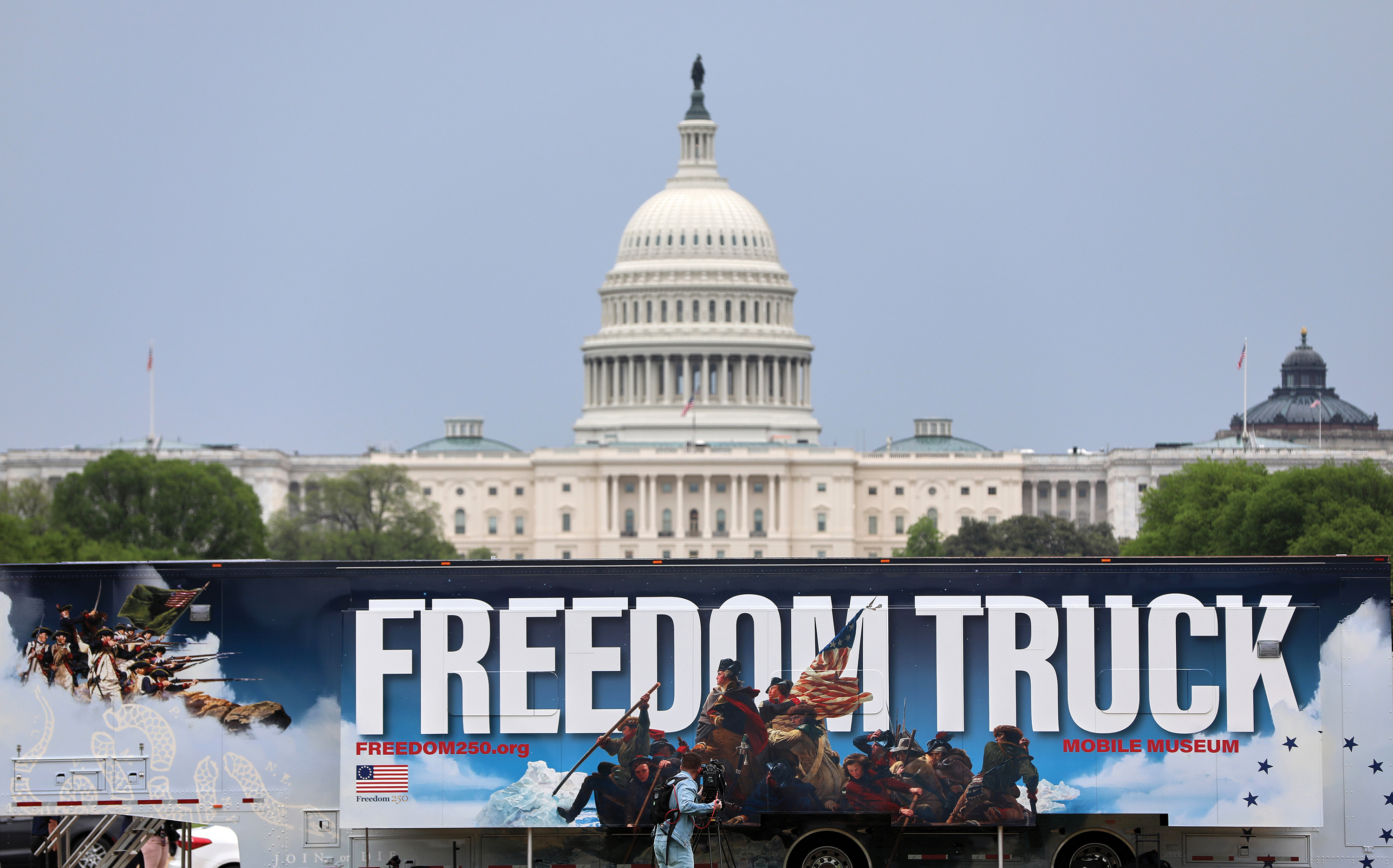
Freedom Trucks, 18-wheel “mobile museums” used to commemorate America's 250th anniversary celebration, arrive at the National Mall in Washington.Associated Press/Photo by Rahmat Gul
ONE HIGH SCHOOL HISTORY TEACHER found herself caught in the middle. Jennifer Welch, 55, spent years driving groups of students from Passaic, N.J., about 80 miles south to visit Independence National Historical Park. Her voice grew tense when she spoke about the slavery exhibit’s removal. In her classroom, Welch said, she relied less on textbooks and more on exposing students to primary documents. But when she learned about Washington’s slaves in the late 2010s, particularly the story of one named Oney Judge, she felt compelled to incorporate lessons telling their stories, too.
“How [students] come down on whether George Washington was a hero or a villain, or somewhere in between, that’s on them,” she said. “My job is to make sure they can write that argument well and have a civil discussion with their classmates.”
But Hartog of Samford University thinks there’s more to it than that. As part of the university’s 250th commemoration, Hartog planned lectures from various speakers discussing portions of the Declaration. In his own classes on early American history, as part of students’ primary source study, he incorporates sermons from clergy in Colonial America.
“It really comes down to which pieces of the American story you think are most important, and what’s going to get prioritized,” he said.
Many trace the deepening divisions over American history to the infiltration of critical theory, or its most commonly known offshoot, critical race theory (CRT). Previously confined to college campuses, the Marxist-based academic discipline holds that America was founded on white supremacy and oppression of marginalized groups—and those forces continue to shape life today.
The 1619 Project from The New York Times became one recognizable signpost of how diffused those ideas had become. The multimedia initiative launched in 2019 aimed at overhauling the claim that America’s story began with the signing of the Declaration of Independence. Instead, it reframed the nation’s origin around the arrival of the first enslaved Africans in Virginia. The project claimed the founders’ motive in declaring the colonies’ independence from Britain was “to ensure that slavery would continue.”
Historians and scholars have since disputed the 1619 Project’s claims. But its ideas and subsequent corresponding curriculum continue to circulate. About 15,300 K–12 teachers have been trained in the curriculum, according to Jon Sawyer, founder and senior adviser at the Pulitzer Center, an educational partner to the Times on the 1619 Project. More than 500 educator partners across 30 states have developed projects related to the curriculum for 25,000 K–12th grade students, Sawyer claimed.
In 2020, Trump established the 1776 Commission to combat the 1619 Project and promote what he felt was severely lacking—patriotic education. The advisory committee included the late TPUSA founder Charlie Kirk, Hillsdale College President Larry Arnn, and Matthew Spalding, vice president for Hillsdale’s Washington, D.C., operations and dean of the Van Andel Graduate School of Government.
Two days before Trump left office in 2021, the group released a 45-page 1776 Report, including what some say were previously indisputable facts about American history. Patriotic education “doesn’t mean ignoring the faults in our past, but rather viewing our history clearly and wholly, with reverence and love,” the report stated. While it addressed the reality that some of the Founders owned slaves, it noted they came to realize slavery was incompatible with the Declaration’s claims that “all men are created equal.”
The American Historical Association and nearly 50 other historical groups condemned the report for its “simplistic interpretation that relies on falsehoods, inaccuracies, omissions, and misleading statements.” Sections on the Founders “envision godlike men” who crafted documents asserting “universal and eternal principles” while erasing the experiences of swaths of marginalized groups, the AHA wrote.
Upon taking office, President Joe Biden immediately disbanded the 1776 Commission.
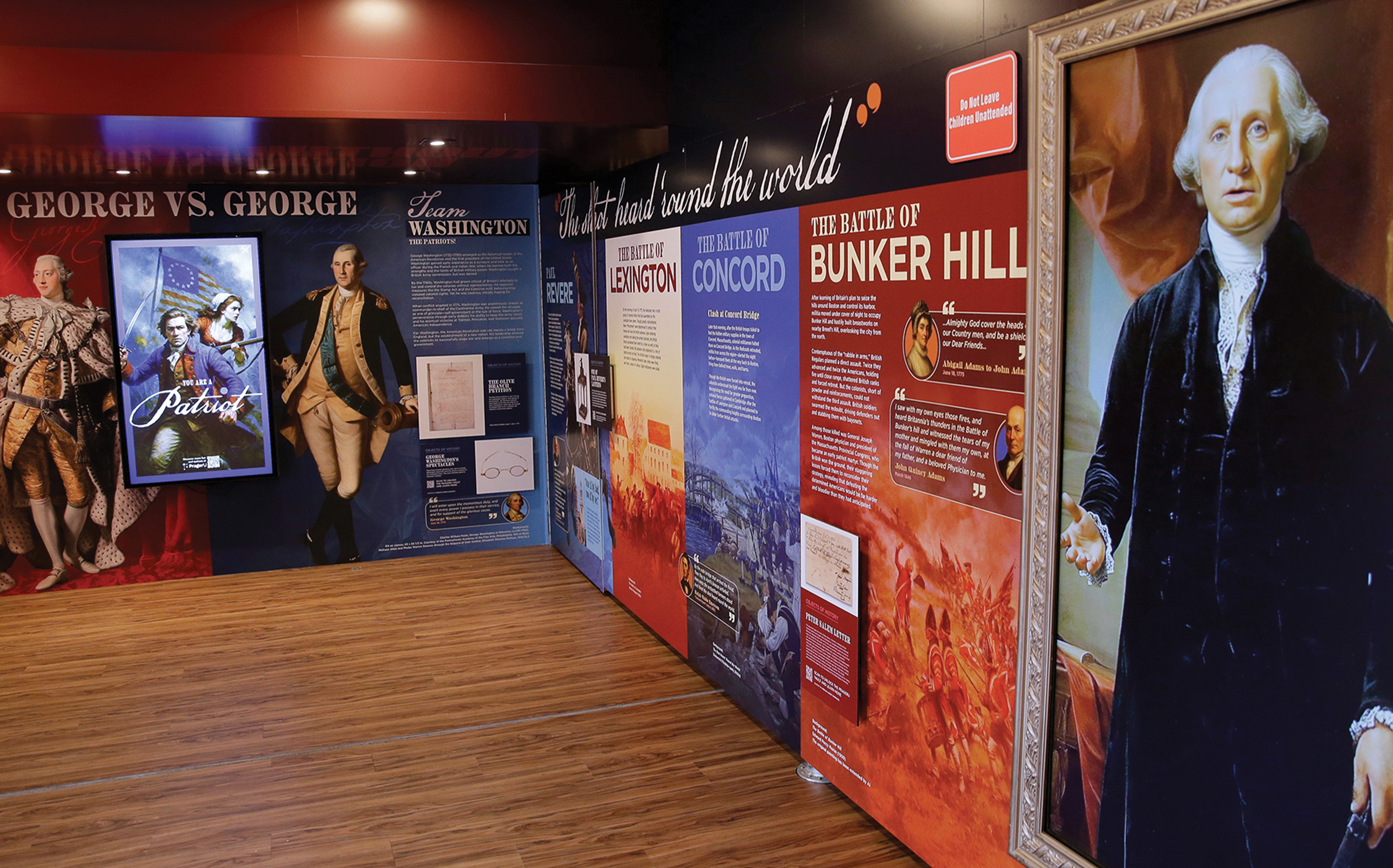
A view inside the Freedom Truck.Associated Press/Photo by Rahmat Gul
BUT SINCE THEN, the so-called history wars have only ramped up. Critics of progressivism and CRT, including parents and conservative activists, grew more outspoken. Conservative investigative journalist Christopher Rufo published numerous CRT-related reports detailing anti-white and anti-American rhetoric in K–12 public school classrooms and curricula.
State legislators took note. In recent years, dozens of states, primarily led by Republican lawmakers, have adopted laws restricting CRT-related content, including how educators teach U.S. history. Those battles continue in statehouses today. In Virginia, after years of wrangling over state history and social studies standards under former Republican Gov. Glenn Youngkin, Democratic lawmakers recently proposed legislation to revise current standards to include more emphasis on the contributions and experiences of so-called marginalized groups, including racial and ethnic minorities, immigrants, and people who identify as homosexual and transgender.
In April, the Texas State Board of Education approved an early draft of new K–12 curriculum standards for social studies that emphasize the importance of students reading U.S. founding documents and gaining an understanding of American and Texas “exceptionalism.” The Republican-led overhaul of social studies standards attracted heated disputes over how much time students should spend learning about cultures other than Western civilization and the influence of Christianity on America’s founding. The board is expected to finalize the new standards in June.
Amid these debates, millions of parents across the country have flocked to homeschooling or classical education. But even in these spaces, a growing contingent champions progressive ideas, including CRT, according to Becky Aniol, a pastor’s wife, homeschooling mother of four, and founder of Living Heritage Homeschool. She cited reading lists aimed at fostering “white guilt” and one homeschooling convention with sessions that included topics like “forms of decoloniality” and another titled “All History Is Queer History.” Earlier this year, Well-Trained Mind, a popular classical homeschooling curriculum publisher, came under fire for posting a lengthy political statement on social media that criticized immigration crackdowns. Some, including Aniol, perceived in the post a leftward turn that raised doubts about the publisher’s newly updated history series, The Story of the World.
In 2025, Aniol and a handful of other homeschooling moms published a statement to “draw attention to dangerous ideas rooted in postmodern thought permeating the culture which have infiltrated home education, philosophy, methods, and community.” History, the statement reads, “tells the unfolding human story as authored by God. As His Story, history should neither be revised or rewritten in an effort to manipulate the present or future, nor should it emphasize propaganda or calls to activism.”
Aniol argues older students can grapple with the complexities of America’s beginning and the Founding Fathers. “But it’s a mistake to teach kids evil first, or evil as equal,” she said. “Young kids especially need to have heroes, not just those who were powerful, but those who had virtue and built our country based on principles that are compatible with a biblical worldview.”
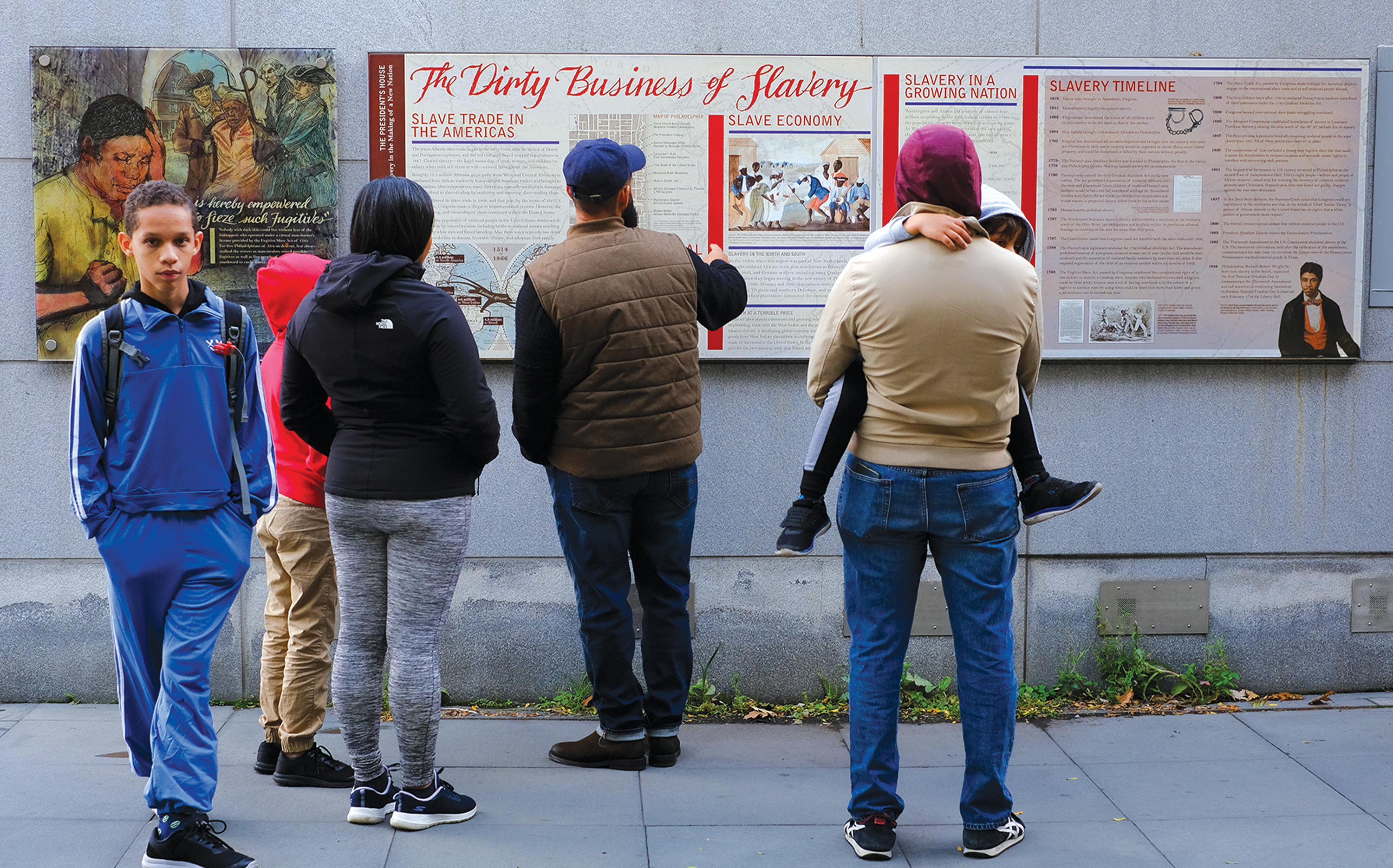
A Family reads the signage about slavery on an outdoor exhibit at Independence National Historical Park in Philadelphia.Michael Yanow/NurPhoto via AP
THE CURRENT FIGHT over views of America’s history dates back to the early 20th century, when progressive historians began weaving a different narrative, one that recast America’s founding in an unfavorable light. Historian Charles Beard popularized the idea that economic interests, not abstract ideas, provided the impetus for the founding documents. Under Beard’s interpretation, America’s Founders were portrayed as “more interested in lining their pockets than taking stock of the common man,” explained Stephen Knott, an author and Thomas & Mabel Guy Professor of American History and Government at Ashland University. In the 1930s, the Institute for Social Research, originally located in Frankfurt, Germany, but relocated to Columbia University, developed a neo-Marxist approach, known as the Frankfurt School, or critical theory, that focused on how social and cultural structures perpetuate class conflict and inequality. By the 1960s and ’70s, the so-called “New Left” and the feminist and civil rights movements gave rise to a historical interpretation centered on race, gender, and sexuality. “For some folks on the left, race and gender became the be-all and end-all,” Knott said.
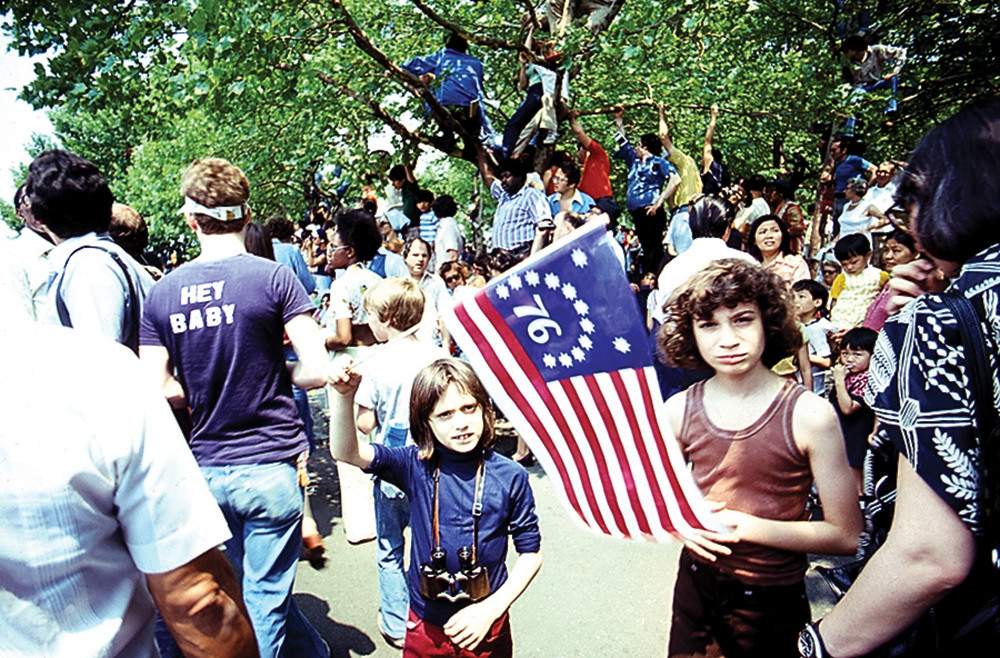
Against this backdrop, America ushered in its 200th anniversary in 1976. The bicentennial landed in the immediate aftermath of the Watergate scandal, President Richard Nixon’s resignation, and the Vietnam War. Knott was 19 and living outside Boston. He recalled protesters shouting down President Gerald Ford while he attempted to give a speech at the North Bridge in Concord to mark the first shots fired during the Revolution. “It wasn’t all peaceful and patriotic,” Knott said.
But for others, America’s founding was still something to be celebrated. Amid social, political, and racial tensions, “there was a sense of, the American endeavor was good, and we’re blessed to be a part of that,” Hartog told me.
Hillsdale’s Matthew Spalding was in middle school in Central California at the time. He recalls a celebratory “immersive experience” on TV and in real life, “with ships, parades, activities, the Freedom Train coming through town.” Spalding said his city painted fire hydrants to look like miniature colonial soldiers. His mother gave him and his brother one crisp new $2 bill each, taking them to the post office to get them stamped. “It sparked my first interest in our nation’s history,” he said.
Four years later, though, Howard Zinn’s book, A People’s History of the United States, became a touchstone in America’s history wars. Zinn, who described himself as “something of an anarchist, something of a socialist,” popularized an interpretation of American history that emphasized race, gender, and ethnicity categories. The book recast the American story as one of oppression against marginalized groups—namely, enslaved Africans, women, Native Americans, and immigrants. Since its publication, the book has sold more than 2 million copies and had an outsized influence on elementary, high school, and college students, including a 2008 graphic novel adaptation for junior high readers.
In 2020, one critic labeled Zinn’s book “fake history that turned a generation against America.” (As recently as last fall, it was required reading for my son at a California community college.) The extent to which younger generations have turned against America is debatable. Indeed, Trump’s return to office accelerated cultural pushback against radical iterations of anti-American and anti-white ideologies in curricula, classrooms, and other historical institutions.
But Spalding believes there’s still much to recover. He spearheaded Hillsdale’s involvement in developing the academic and educational content for Freedom Trucks. “This is a unique moment to capture the imagination and remind people of the history and revive it,” he said.
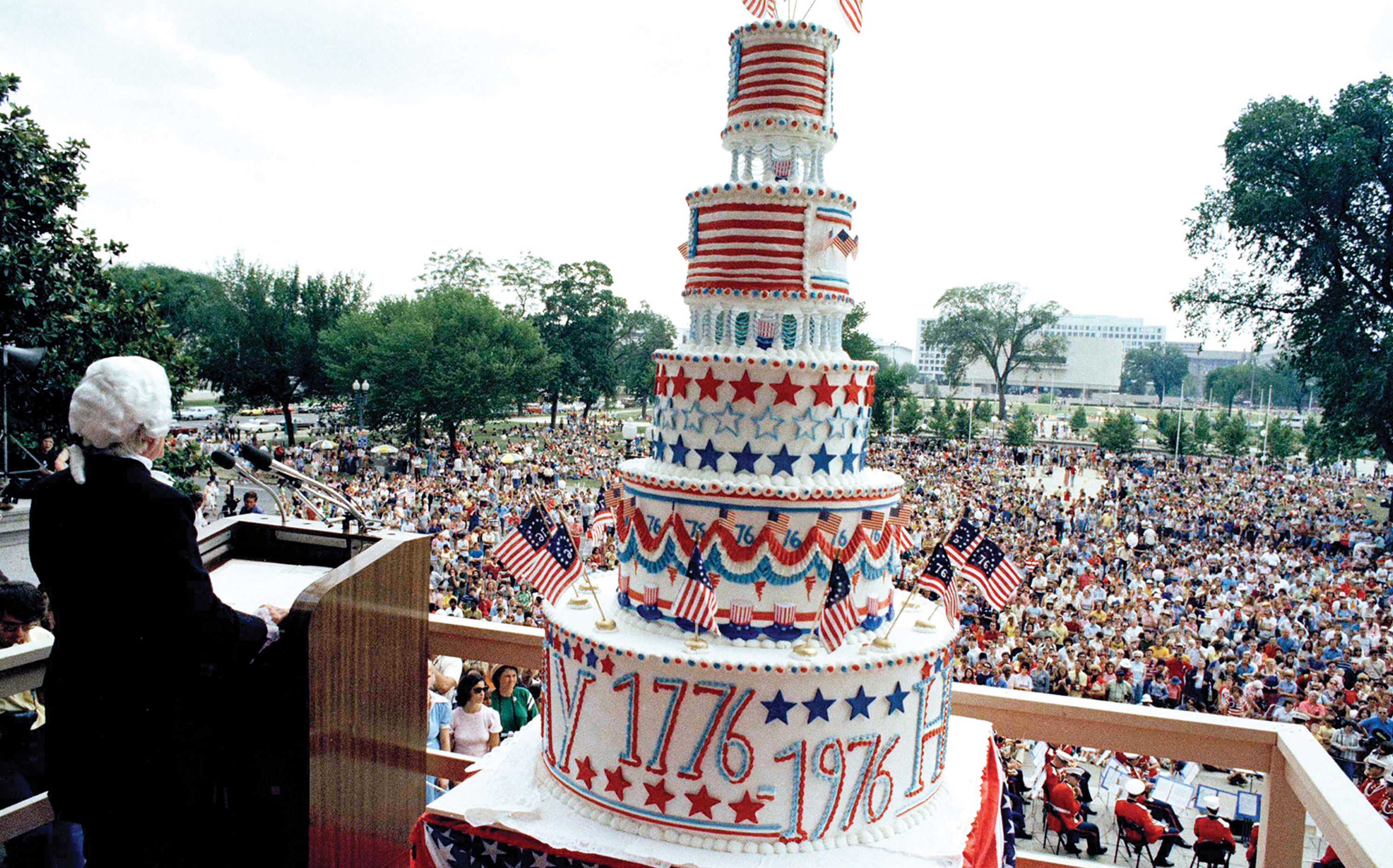
A man dressed in period costume speaks to a crowd celebrating the bicentennial in Washington, D.C., on July 4, 1976.Associated Press
FOR SOME WHO VISITED the Freedom Truck in Middletown, the conservative groups behind the museum were a selling point. “We knew they’d have a good idea of what the Revolution was about,” said Nicole Russell, a homeschooling mom who toured the truck with her four children.
The exhibits, presented in patriotic colors and eye-catching fonts, included a timeline of the major battles, an interactive map showing the westward expansion, and a quiz for visitors to determine whether they would have been a Loyalist or a Patriot during the Revolutionary era. One touch screen display informed visitors about lesser-known figures of the revolution: “slaves seeking liberty, women holding families together, Jewish merchants funding the cause, Indians navigating alliances, and pastors igniting revolution.”
The displays highlight America’s Judeo-Christian roots and center around the Declaration’s key argument: that God, not the government, gives individuals their rights. A large AI-generated version of Washington welcomed visitors to the two-room museum. “Despite our differences, we agreed on one fundamental truth,” Washington says in a deep voice. “That our rights are a gift from God, not a favor from kings or courts.”
Despite our differences, we agreed on one fundamental truth: That our rights are a gift from God, not a favor from kings or courts.
Meghan Fisher visited the Freedom Truck with her red-haired 8-year-old daughter, Lily. Fisher, 47, was initially concerned that the museum would de-emphasize slavery. Toward the end of their visit, she noted one display that acknowledged it took decades to fulfill the truth that “all men are created equal and endowed with unalienable rights.”
Lily, her almost waist-length hair pulled back from her face with two bright pink bows, seemed excited to explore the truck. “We’re here to celebrate the birthday,” she explained.
“The birthday of America,” her mother finished for her with a smile.Fisher said she chose to homeschool her daughter, despite working for an education publisher. “I’ve been in a lot of different schools over the years, and I just wanted to be able to choose what she learned,” she said. “Sadly, like everything else, [history] has become really political.”
—with additional reporting from Addie Offereins
Historical Studies Timeline
1791
The Massachusetts Historical Society becomes the nation’s first organization devoted to collecting materials for the study of American history.
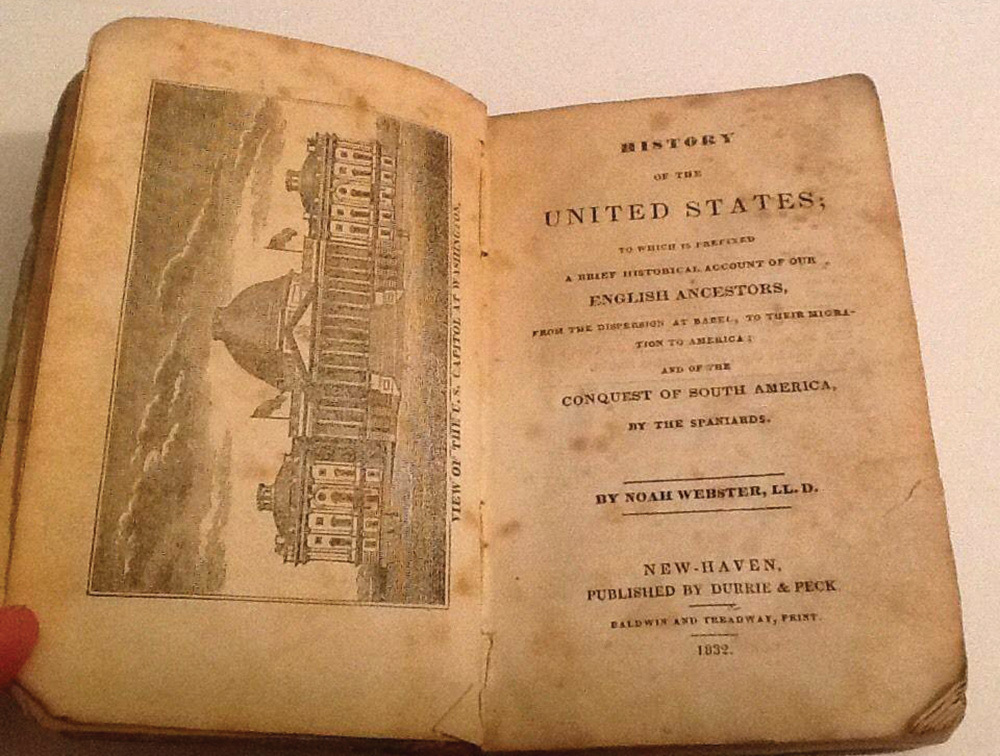
1832
Noah Webster publishes History of the United States. This narrative-driven account is often considered the first American history textbook.
Late 1800s
The study of history shifts from a literary pursuit to an academic discipline in which scholars began employing an empirical scientific approach. German historian Leopold von Ranke helps popularize rigorous historical research using primary sources.
1882
Yale awards the first specialized Ph.D. in History to Clarence Bowen, a journalist who completed his dissertation on “The Boundaries of Connecticut.”
1884
The American Historical Association is founded to collect and preserve historical manuscripts and disseminate historical research.
1913
Progressive historian Charles A. Beard publishes An Economic Interpretation of the Constitution of the United States, giving rise to the idea that the Founding Fathers were motivated by financial interests rather than principled ideals.
1934
The Institute for Social Research in Frankfurt, Germany, credited as the birthplace of the Frankfurt School and critical theory, relocates to Columbia University in New York City. Frankfurt theorists promoted ideas that spread through universities and intellectual circles, critiquing capitalism’s perceived effect on social and cultural structures.
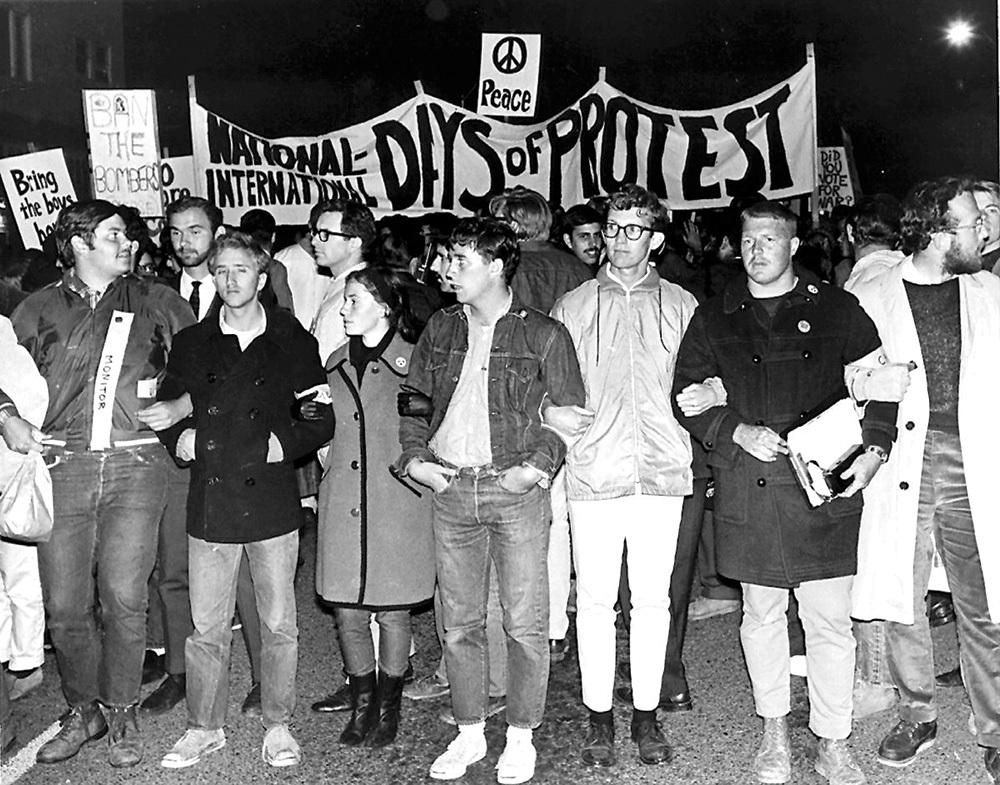
Lonnie Wilson/Oakland Tribune Staff Archives/Digital First Media Group/Oakland Tribune via Getty Images
Mid-1900s
The rise of what historian John Higham termed “consensus history,” a countermovement to progressive historiography that emphasized national identity and shared American ideals.
Early 1960s
The New Left emerges at the University of California, Berkeley and University of Michigan. This student-led radical political movement drew on Frankfurt theorists to redefine oppression, from economic struggles to modern identity politics.
1976
America turns 200 amid a groundswell of patriotism, despite political upheaval.
1980
Howard Zinn publishes A People’s History of the United States. The hugely popular American history book recasts history through the lens of marginalized people groups.
David Attie/Getty Images
2019
The New York Times publishes the 1619 Project, which argues that U.S. history should begin with the arrival of the first slaves.
2020
During his first term, President Donald Trump establishes the 1776 Commission to counter the 1619 Project and support “patriotic education.”
2025
Trump issues the executive order “Restoring Truth and Sanity to American History.” The order directed the Interior Department to ensure properties under its jurisdiction do not “inappropriately disparage Americans past or living.” —M.J.

관련링크
댓글목록 0
등록된 댓글이 없습니다.


